Sample size calculation check list. The survey and estimate sample size separately for each of these important items.
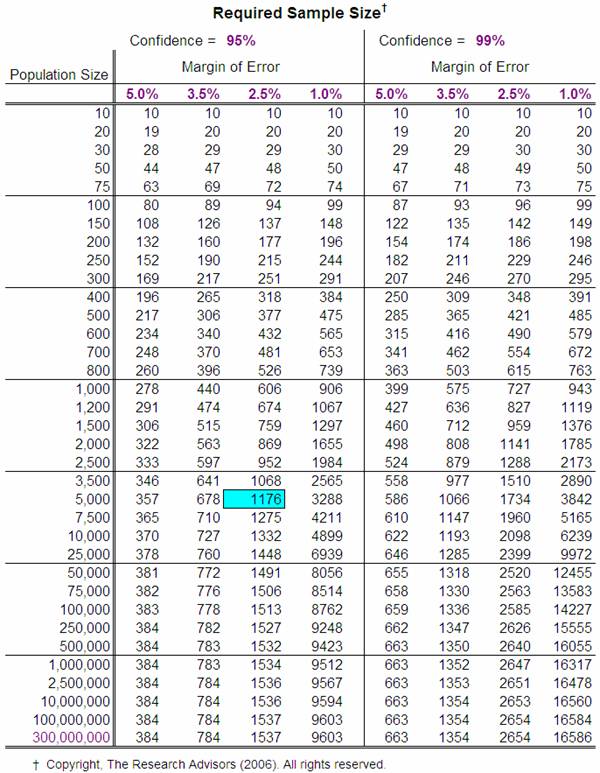
Sample Size Table
If the population size is smaller, use the sample size calculator.

Survey sample size. Most statisticians agree that the minimum sample size to get any kind of meaningful result is 100. For delighted customers with an extremely large customer base, it may not be completely practical to survey each and every person. A good maximum sample size is usually 10% as long as it does not exceed 1000.
The other point of view is that while maintaining a representative sample is essential, the more respondents you have the better. Sample size is the amount of people you need to take your survey or who have completed your survey. What is the probability of the event occurring?
If you were taking a random sample of people across the u.k., then your population size would be just under 68 million. How many people are you talking about in total? The larger your sample size, the more sure you can be that their answers truly reflect the population.
How to calculate sample size This equation should be used when the size of the population is very large. If your population is less than 100 then you really need to survey all of them.
The population size is the size of the entire community of people you wish to represent with the survey results. We’ve broken the process into 5 steps, allowing you to easily calculate your ideal sample size and ensure accuracy in your. The batch of people who respond to your survey.
The sample size is defined by the formula illustrated. For example, one way of sampling is to use a “random sample,” where respondents are chosen entirely by chance from the. There can be two different sample sizes.
Similarly, if you were surveying your company, the size of the population would be the total number of employees. It's a sample because it represents a part of the total group of people whose opinions or behavior you care about. Researchers have found that taro yamane's simple percentage formula helps select the sample size.
You don’t need to be a mathematician to work out your survey sample size for some surveys. As we chose a margin of error of 5% and a confidence level of 95% for our ‘fall 2016’ campaign, you need approximately 400 completes (it is advisable to. As a result, researchers would get a range of sample sizes, i.e.
The number of respondents who take your survey is a sample size. The total number of the population you are studying. Before you can calculate a sample size, you need to determine a few things about the target population and the level of accuracy you need:
After crunching all those numbers, (or using our calculator, if you’re smart), you’ll find a number that defines how many responses you need to receive for your survey to meet the criteria you’ve set for it. How to calculate a survey sample size based on population, expected respondents, margin of error and confidence rate. Those 10 are the sample and the 50 are the population.
Consider your sample size variables. Depending on the confidence level and the margin of error, the number of completes will vary. As a summary, to determine the sample size needed in a survey, we need to answer the following questions:
Sample size is the number of completed responses your survey receives. Small sample sizes for scaled/continuous What type of data analysis will be conducted?
The total number of people in the group you are trying to study. However, the relationship is not linear (i.e., doubling the sample size does not halve the confidence interval). As an example, you can select at random 10 out of 50 employees from a department at your job.
The minimum sample size is 100. Essentially, sample sizes are used to represent parts of a population chosen for any given survey or experiment. To carry out this calculation, set the margin of error, ε , or the maximum distance desired for the sample estimate to deviate from the true value.
The formula denotes by n the sample size, = 1 + ( ) 2 where n is the population size and e=margin. It’s called a sample because it only represents part of the group of people (or target population) whose opinions or behavior you care about. A good maximum sample size is usually around 10% of the population, as long as this.
Basic surveys, such as feedback forms, opinion surveys, or surveys that use random sampling, use a simple formula. This indicates that for a given confidence level, the larger your sample size, the smaller your confidence interval.

Developing Questionnaire Survey And Calculating Sample Size - Qualitative Research | - Youtube